He navigated 9/11, expanded NFL, brought labor peace — Paul Tagliabue: 1940-2025
Hall of Famer Forever
Published on : 11/9/2025
The professional football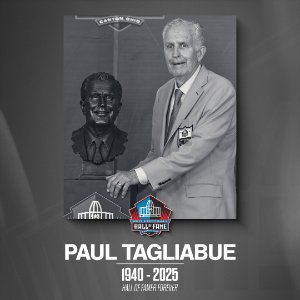 world today is celebrating the life and contributions of PAUL TAGLIABUE, who led the National Football League to unprecedented heights as its seventh full-time commissioner.
Tagliabue, a member of the Pro Football Hall of Fame’s Centennial Class of 2020, died Sunday morning, Nov. 9, 2025, according to the League and Commissioner Roger Goodell, who succeeded Tagliabue’s 17-year tenure in the office.
In a statement, Tagliabue's family said he died at his Chevy Chase, Md., home. The cause of death was heart failure from complicated by Parkinson's disease.
He was 84.
“The mission of the Pro Football Hall of Fame is to honor the greatest of the game – whether they play, coach or contribute – and Commissioner Paul Tagliabue certainly can be counted among its foremost contributors,” Hall of Fame President & CEO Jim Porter said Sunday. “Many will remember how he skillfully led the League’s widely respected and appropriate response to the tragedy of Sept. 11, 2001. Also noteworthy: the labor peace the League enjoyed under his tenure, record broadcast deals, the establishment of international games and the expansion to the current 32 NFL teams.
“You simply cannot tell the history of the National Football League without repeated praise of the job Paul Tagliabue did as commissioner, and also as the league’s lead attorney before taking that top role.”
Tagliabue succeeded longtime Commissioner PETE ROZELLE in 1989 and served through Sept. 1, 2006. Under his guidance, the NFL:
“I think, just recently, a lot of people, including even some owners in the NFL, are starting to understand the wonderful spectacle of talent and leadership and vision that this guy brought to the job.”
Tagliabue’s success in the role took some by surprise. His ascension to the position required three owners meetings, in three cities; the aid of a New York-based executive search company; three search committees of NFL owners; more than 50 hours of debate and 11 ballots for the owners to choose him over JIM FINKS, the vice president and general manager of the New Orleans Saints at that time and himself a future Hall of Famer (Class of 1995).
Ultimately, owners came to realize the steady Tagliabue could continue the work Rozelle started while bringing a new approach and fresh ideas.
In his Enshrinement speech in 2020, Tagliabue said his “journey in pro football began in 1969, quite a few years ago, as a young attorney in Washington, D.C., representing the NFL. Over the next two decades, I was privileged to learn a lot about the game and the business of football, working with Commissioner Pete Rozelle and league leaders, giants of the league, such as the New York Giants’ WELLINGTON MARA, the Chiefs’ LAMAR HUNT, the Steelers’ DAN ROONEY and the Cowboys’ TEX SCHRAMM.
“It was Dan Rooney who explained to me early on, and I quote him. He said, ‘Paul, some teams are a lot better at winning than others, but when it comes to League business, we're all equal. So in deciding what the League should do, don't give too much weight to any one owner.’
“It was good advice,” Tagliabue continued. “Commissioner Rozelle was superb at persuading owners to put aside their own agendas for the overall good of the League. When I succeeded him in 1989, I knew I wanted to maintain his fundamental principle: ‘Think League first.’ Those were the three words he said so often. ‘Think League first.’”
In his memoir “Jersey City to America’s Game” published shortly after his enshrinement, Tagliabue reiterated that mantra.
“Think league first and clubs second. It’s never about I or me; it’s always we or us,” he wrote.
When Tagliabue took over as commissioner, he wrote in the memoir: “… there had been decades of acrimony between the clubs and the Players Association; divisive and protracted litigation over team relocation; no League expansion with new teams in almost in 15 years; flat television revenues; and sometimes a concern that other sports were shrinking the League’s once unquestioned lead in popularity.”
Tagliabue said he learned by entering the belly of the beast – the NFL locker room. Over his first few months as commissioner, he met with players from several teams to hear their views on pension and health care benefits, drug testing, artificial turf, free agency and other issues of importance to them. He later started a Player Advisory Council and, importantly, heeded its advice regularly.
One author called Tagliabue “a brilliant engineer who anticipated many of the League’s challenges and addressed them with skill and vision.”
Paul John Tagliabue was born Nov. 24, 1940, in Jersey City, N.J. His parents, both children of emigrants from Italy, instilled values that would show themselves consistently in Tagliabue’s professional career.
His father “possessed an internal compass that had one true north: As he saw it, hard work was both the purpose of life and the solution to most problems,” Tagliabue wrote. His mother was “strong-willed and wise to the world of hard knocks … with high expectations for her four sons.”
While athletic endeavors were encouraged, academics were stressed. Tagliabue gravitated to books and basketball, eventually earning all-star status in the New York-New Jersey area in the late 1950s and the attention of more than two dozen colleges offering scholarships to play basketball.
He chose Georgetown, mainly on academic reputation, played basketball and was a team captain.
“By my junior year, my love for basketball was losing out to my love for the library,” Tagliabue admitted in a commencement address to the Class of 2006 at Georgetown. “I was more interested in debating communism and democracy with the political science faculty than in shooting baskets.”
After graduating, he attended law school at New York University, where in 1964 he met his future wife, Chandler “Chan” Minter. They were married in 1965.
He worked briefly as a policy analyst in the U.S. Defense Department before joining the Washington, D.C., law firm Covington & Burling, the NFL’s principal outside counsel, where he stayed until becoming commissioner.
As the NFL’s counsel, Tagliabue left his impression on Rozelle, League personnel and owners as a prepared, unflappable, reliable and sharp legal mind.
Don Weiss, a former NFL executive director, once shared that when asked about important League matters, Rozelle typically responded, “What does Paul think?”
In a handwritten letter following the successful conclusion of the USFL antitrust lawsuit in August 1986, Rozelle thanked Tagliabue for “the guts you showed in Palm Springs” and the suit’s positive outcome.
The compliment came in reference to Tagliabue’s insistence at the Palm Springs owners’ meeting that the owners not settle the suit before trial, which some owners advocated. His strong stance convinced even hardliners like Hugh Culverhouse (Buccaneers), who also wrote to Tagliabue.
“Your courage is admirable,” Culverhouse wrote, “and I do appreciate what you have done and are doing for the NFL and its owners.”
Then-NFL Executive Director Jay Moyer, who also attended that meeting, remembered that Tagliabue’s remarks nipped in the bud any question of settling.
“Paul was very levelheaded. It was not the least histrionic at all. It was very matter-of-fact and sensible, and everybody responded to it,” Moyer said.
Much of what Tagliabue accomplished was done with that level-headedness and without fanfare or self-serving bravado. He shunned the spotlight. His supporters called him confident, proactive and a master at forming coalitions with important stakeholders.
“Great commissioners are like great boxing referees,” sportswriter Jerry Izenberg once wrote of Tagliabue. “The best refs work without being noticed, and the best commissioners do their best work behind closed doors.”
Tagliabue also used his office and authority quietly to advance opportunities of social responsibility, exemplified by such initiatives as the “Rooney Rule,” which required minority candidates to be interviewed for certain jobs, and moving the Super Bowl site from Phoenix to Pasadena, Calif., after Arizona refused to establish a state holiday recognizing the work of Dr. Martin Luther King Jr. in 1991.
When pressed for a signature accomplishment, Tagliabue said he was most proud of the NFL’s collective response to the catastrophic events surrounding the terrorist attacks on the World Trade Center and Pentagon on Sept. 11, 2001.
Two days after the 9/11 attacks, Tagliabue said all NFL games scheduled for the upcoming weekend would be canceled. It would mark the first time the league canceled an entire week's slate of games since the 1987 NFL strike.
A week later, the League said the postponed games would be added to the end of the regular season, pushing the Super Bowl into February for the first time.
“It was darkness. It was hell,” Tagliabue said of the post-attack atmosphere. “I’ve learned from that experience and from Katrina (in 2005), that when you’re in the midst of a tragedy where there’s loss of life, you’re in darkness. I’d compare it to hell.
“What is required by people outside the immediate area of devastation is leadership and hope. Hope can bring some light to that dark and seemingly endless experience.”
Exactly how to respond after 9/11 wasn’t simple. Owners Wellington Mara (Giants) and Jerry Richardson (Panthers) told Tagliabue that postponing the games would be giving in to the terrorists. Players on 11 teams polled by the NFLPA initially voted to play their games that weekend; other teams’ players said they would forfeit rather than play.
In the end, Tagliabue made the call.
“I think if you’re a chief executive, or you’re the captain of the basketball team, or you’re the principal of the school, you know that it’s your responsibility to lead and to make decisions,” he said in an interview with the Hall of Fame.
“Leadership is about lots of things, but it includes making decisions and making hard choices. It also means acting quickly in crises … It was clear that we had a platform that was respected. We had a voice that would be listened to if it was saying intelligent things. I think the league can really set a tone and be a leader in ways that go quite beyond football games.
“At the time, the country was looking for leaders who were doing things that people felt needed to be done. I think most of all, it was, ‘Forget about your differences. Forget about your own needs. Focus on what you have in common with other people and focus on the needs of others. Make it your own responsibility to support others and be a good citizen.’ I felt from the beginning, ‘Don’t worry about replaying the week of games that we’re canceling. In some way, we’ll get that done.’ That was a detail.”
John Mara, president & CEO of the Giants since his father’s death in 2005, said of Tagliabue: “I think his leadership after the 9/11 attacks was his finest hour. He made the decision not to play and coordinated the response, which I believe greatly aided our country’s healing.”
The late PAT BOWLEN, elected to the Hall of Fame a year before Tagliabue in 2019, said of him: “I don’t think any of us could have expected any more out of him. There was no question in my mind that we got 110 percent out of Paul Tagliabue as commissioner of the National Football League.”
Tagliabue’s legacy in the game of professional football will be preserved in Canton, Ohio.
world today is celebrating the life and contributions of PAUL TAGLIABUE, who led the National Football League to unprecedented heights as its seventh full-time commissioner.Tagliabue, a member of the Pro Football Hall of Fame’s Centennial Class of 2020, died Sunday morning, Nov. 9, 2025, according to the League and Commissioner Roger Goodell, who succeeded Tagliabue’s 17-year tenure in the office.
In a statement, Tagliabue's family said he died at his Chevy Chase, Md., home. The cause of death was heart failure from complicated by Parkinson's disease.
He was 84.
“The mission of the Pro Football Hall of Fame is to honor the greatest of the game – whether they play, coach or contribute – and Commissioner Paul Tagliabue certainly can be counted among its foremost contributors,” Hall of Fame President & CEO Jim Porter said Sunday. “Many will remember how he skillfully led the League’s widely respected and appropriate response to the tragedy of Sept. 11, 2001. Also noteworthy: the labor peace the League enjoyed under his tenure, record broadcast deals, the establishment of international games and the expansion to the current 32 NFL teams.
“You simply cannot tell the history of the National Football League without repeated praise of the job Paul Tagliabue did as commissioner, and also as the league’s lead attorney before taking that top role.”
Tagliabue succeeded longtime Commissioner PETE ROZELLE in 1989 and served through Sept. 1, 2006. Under his guidance, the NFL:
- Expanded from 28 to 32 teams.
- Developed talent and grew the game internationally through the World League of American Football and, later, NFL Europe.
- Adopted instant replay.
- Built the first internet site by a major sports league.
- Navigated the challenges of the 9/11 terrorist attacks in 2001 and Hurricane Katrina in 2005.
- Signed record television rights deals.
- Enjoyed labor peace with lengthy collective bargaining agreements.
- Increased league-wide revenue sharing, adopted a salary cap and expanded free agency, all of which helped create parity in the league and the opportunity for teams to rebound quickly from losing seasons.
- Oversaw several new stadium projects.
“I think, just recently, a lot of people, including even some owners in the NFL, are starting to understand the wonderful spectacle of talent and leadership and vision that this guy brought to the job.”
Tagliabue’s success in the role took some by surprise. His ascension to the position required three owners meetings, in three cities; the aid of a New York-based executive search company; three search committees of NFL owners; more than 50 hours of debate and 11 ballots for the owners to choose him over JIM FINKS, the vice president and general manager of the New Orleans Saints at that time and himself a future Hall of Famer (Class of 1995).
Ultimately, owners came to realize the steady Tagliabue could continue the work Rozelle started while bringing a new approach and fresh ideas.
In his Enshrinement speech in 2020, Tagliabue said his “journey in pro football began in 1969, quite a few years ago, as a young attorney in Washington, D.C., representing the NFL. Over the next two decades, I was privileged to learn a lot about the game and the business of football, working with Commissioner Pete Rozelle and league leaders, giants of the league, such as the New York Giants’ WELLINGTON MARA, the Chiefs’ LAMAR HUNT, the Steelers’ DAN ROONEY and the Cowboys’ TEX SCHRAMM.
“It was Dan Rooney who explained to me early on, and I quote him. He said, ‘Paul, some teams are a lot better at winning than others, but when it comes to League business, we're all equal. So in deciding what the League should do, don't give too much weight to any one owner.’
“It was good advice,” Tagliabue continued. “Commissioner Rozelle was superb at persuading owners to put aside their own agendas for the overall good of the League. When I succeeded him in 1989, I knew I wanted to maintain his fundamental principle: ‘Think League first.’ Those were the three words he said so often. ‘Think League first.’”
In his memoir “Jersey City to America’s Game” published shortly after his enshrinement, Tagliabue reiterated that mantra.
“Think league first and clubs second. It’s never about I or me; it’s always we or us,” he wrote.
When Tagliabue took over as commissioner, he wrote in the memoir: “… there had been decades of acrimony between the clubs and the Players Association; divisive and protracted litigation over team relocation; no League expansion with new teams in almost in 15 years; flat television revenues; and sometimes a concern that other sports were shrinking the League’s once unquestioned lead in popularity.”
Tagliabue said he learned by entering the belly of the beast – the NFL locker room. Over his first few months as commissioner, he met with players from several teams to hear their views on pension and health care benefits, drug testing, artificial turf, free agency and other issues of importance to them. He later started a Player Advisory Council and, importantly, heeded its advice regularly.
One author called Tagliabue “a brilliant engineer who anticipated many of the League’s challenges and addressed them with skill and vision.”
Humble roots
Paul John Tagliabue was born Nov. 24, 1940, in Jersey City, N.J. His parents, both children of emigrants from Italy, instilled values that would show themselves consistently in Tagliabue’s professional career.His father “possessed an internal compass that had one true north: As he saw it, hard work was both the purpose of life and the solution to most problems,” Tagliabue wrote. His mother was “strong-willed and wise to the world of hard knocks … with high expectations for her four sons.”
While athletic endeavors were encouraged, academics were stressed. Tagliabue gravitated to books and basketball, eventually earning all-star status in the New York-New Jersey area in the late 1950s and the attention of more than two dozen colleges offering scholarships to play basketball.
He chose Georgetown, mainly on academic reputation, played basketball and was a team captain.
“By my junior year, my love for basketball was losing out to my love for the library,” Tagliabue admitted in a commencement address to the Class of 2006 at Georgetown. “I was more interested in debating communism and democracy with the political science faculty than in shooting baskets.”
After graduating, he attended law school at New York University, where in 1964 he met his future wife, Chandler “Chan” Minter. They were married in 1965.
He worked briefly as a policy analyst in the U.S. Defense Department before joining the Washington, D.C., law firm Covington & Burling, the NFL’s principal outside counsel, where he stayed until becoming commissioner.
As the NFL’s counsel, Tagliabue left his impression on Rozelle, League personnel and owners as a prepared, unflappable, reliable and sharp legal mind.
Don Weiss, a former NFL executive director, once shared that when asked about important League matters, Rozelle typically responded, “What does Paul think?”
In a handwritten letter following the successful conclusion of the USFL antitrust lawsuit in August 1986, Rozelle thanked Tagliabue for “the guts you showed in Palm Springs” and the suit’s positive outcome.
The compliment came in reference to Tagliabue’s insistence at the Palm Springs owners’ meeting that the owners not settle the suit before trial, which some owners advocated. His strong stance convinced even hardliners like Hugh Culverhouse (Buccaneers), who also wrote to Tagliabue.
“Your courage is admirable,” Culverhouse wrote, “and I do appreciate what you have done and are doing for the NFL and its owners.”
Then-NFL Executive Director Jay Moyer, who also attended that meeting, remembered that Tagliabue’s remarks nipped in the bud any question of settling.
“Paul was very levelheaded. It was not the least histrionic at all. It was very matter-of-fact and sensible, and everybody responded to it,” Moyer said.
Quiet leadership
Much of what Tagliabue accomplished was done with that level-headedness and without fanfare or self-serving bravado. He shunned the spotlight. His supporters called him confident, proactive and a master at forming coalitions with important stakeholders.“Great commissioners are like great boxing referees,” sportswriter Jerry Izenberg once wrote of Tagliabue. “The best refs work without being noticed, and the best commissioners do their best work behind closed doors.”
Tagliabue also used his office and authority quietly to advance opportunities of social responsibility, exemplified by such initiatives as the “Rooney Rule,” which required minority candidates to be interviewed for certain jobs, and moving the Super Bowl site from Phoenix to Pasadena, Calif., after Arizona refused to establish a state holiday recognizing the work of Dr. Martin Luther King Jr. in 1991.
When pressed for a signature accomplishment, Tagliabue said he was most proud of the NFL’s collective response to the catastrophic events surrounding the terrorist attacks on the World Trade Center and Pentagon on Sept. 11, 2001.
Two days after the 9/11 attacks, Tagliabue said all NFL games scheduled for the upcoming weekend would be canceled. It would mark the first time the league canceled an entire week's slate of games since the 1987 NFL strike.
A week later, the League said the postponed games would be added to the end of the regular season, pushing the Super Bowl into February for the first time.
“It was darkness. It was hell,” Tagliabue said of the post-attack atmosphere. “I’ve learned from that experience and from Katrina (in 2005), that when you’re in the midst of a tragedy where there’s loss of life, you’re in darkness. I’d compare it to hell.
“What is required by people outside the immediate area of devastation is leadership and hope. Hope can bring some light to that dark and seemingly endless experience.”
Exactly how to respond after 9/11 wasn’t simple. Owners Wellington Mara (Giants) and Jerry Richardson (Panthers) told Tagliabue that postponing the games would be giving in to the terrorists. Players on 11 teams polled by the NFLPA initially voted to play their games that weekend; other teams’ players said they would forfeit rather than play.
In the end, Tagliabue made the call.
“I think if you’re a chief executive, or you’re the captain of the basketball team, or you’re the principal of the school, you know that it’s your responsibility to lead and to make decisions,” he said in an interview with the Hall of Fame.
“Leadership is about lots of things, but it includes making decisions and making hard choices. It also means acting quickly in crises … It was clear that we had a platform that was respected. We had a voice that would be listened to if it was saying intelligent things. I think the league can really set a tone and be a leader in ways that go quite beyond football games.
“At the time, the country was looking for leaders who were doing things that people felt needed to be done. I think most of all, it was, ‘Forget about your differences. Forget about your own needs. Focus on what you have in common with other people and focus on the needs of others. Make it your own responsibility to support others and be a good citizen.’ I felt from the beginning, ‘Don’t worry about replaying the week of games that we’re canceling. In some way, we’ll get that done.’ That was a detail.”
John Mara, president & CEO of the Giants since his father’s death in 2005, said of Tagliabue: “I think his leadership after the 9/11 attacks was his finest hour. He made the decision not to play and coordinated the response, which I believe greatly aided our country’s healing.”
The late PAT BOWLEN, elected to the Hall of Fame a year before Tagliabue in 2019, said of him: “I don’t think any of us could have expected any more out of him. There was no question in my mind that we got 110 percent out of Paul Tagliabue as commissioner of the National Football League.”
Tagliabue’s legacy in the game of professional football will be preserved in Canton, Ohio.
Previous Article
Kevin Mawae encourages students to surround themselves with ‘positive’ friends
Courage and protecting your goals from negativity comprised the powerful opening message when Pro Football Hall of Famer Kevin Mawae visited Canton recently for an installment of the 2025-2026 Heart of a Hall of Famer program connected by Extreme Networks.
Next Article
Kellen Winslow tells students to surround themselves with good people
Students in Michigan heard a message of humility, teamwork and dreaming big as Hall of Famer Kellen Winslow visited Fordson High School in a recent installment of the Pro Football Hall of Fame’s Heart of a Hall of Famer program connected by Extreme Networks.