Doug Flutie: From magic to mentor
NFL
Published on : 10/15/2025
By Ryan Michael
Special to the Pro Football Hall of Fame
(Editor’s note: This article is the latest in an ongoing series looking at quarterbacks’ achievements that have aged well over the past 80 NFL seasons.)
Doug Flutie’s football career defied conventional boundaries, spanning three leagues, two countries and more than two decades of memorable moments, improbable comebacks and record-shattering performances.
From his legendary “Hail Mary” at Boston College to rewriting the record books in the Canadian Football League – and ultimately engineering a remarkable NFL resurgence in his late 30s – Flutie’s path was anything but traditional.
Undersized, underestimated and often overlooked, he rose time and again to deliver when it mattered most. He left behind not only a staggering statistical legacy, but also a blueprint for perseverance, creativity and resilience in the unpredictable and often unforgiving world of professional football.
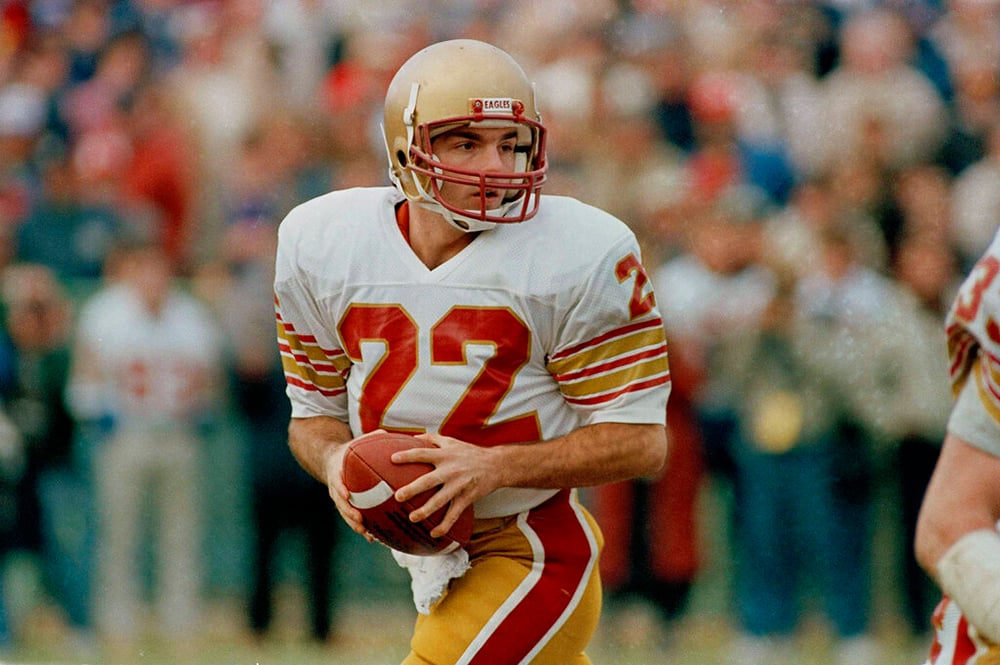
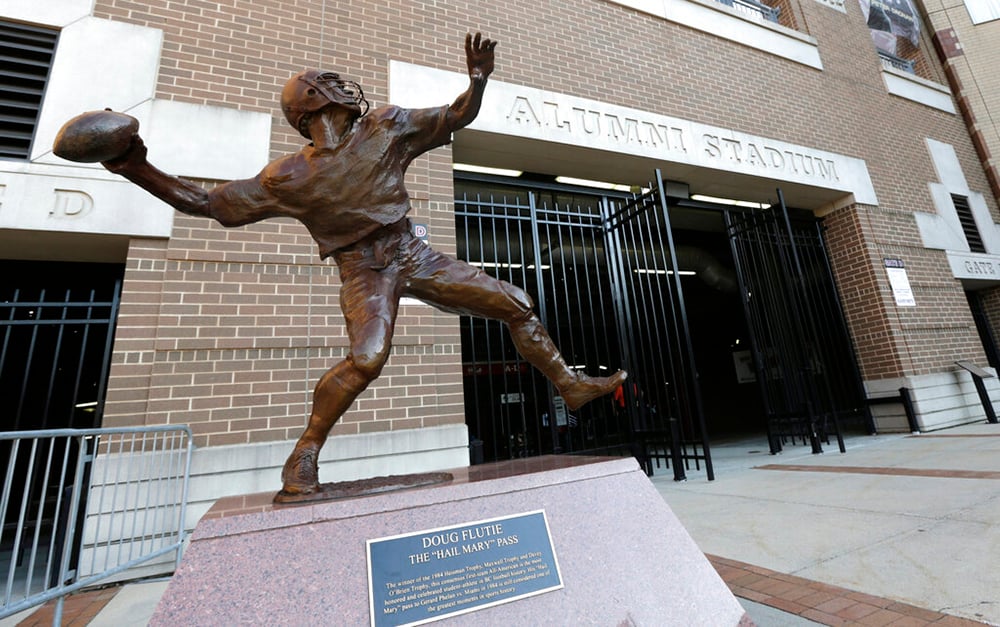
That journey began in earnest at Boston College, where Flutie’s four-year tenure reached its pinnacle in 1984, when he captured the Heisman Trophy following a standout senior season. In one of college football’s most iconic moments, with seconds remaining on the clock, Flutie rolled to his right and launched a 63-yard “Hail Mary” pass into the end zone. Against all odds, the ball connected with wide receiver Gerard Phelan, securing a dramatic 47-45 victory over the Miami Hurricanes in the Orange Bowl.
Flutie concluded his collegiate career with 677 completions for 10,579 yards and 67 touchdowns.
Flutie’s professional football career began not in the NFL but in the now-defunct United States Football League (USFL). In 1985, he signed a landmark five-year, $7 million contract with Donald Trump’s New Jersey Generals, making him the highest-paid player in professional football at the time across any league.
His professional debut came in February 1985 against the Orlando Renegades, a highly anticipated moment that fell well short of expectations. His first two professional passes were intercepted, and he ended the game without producing a touchdown. Despite the rocky start to the season, Flutie eventually showed flashes of the dynamic playmaking that defined his Boston College career.
Over 15 games, he completed 134 of 281 passes for 2,109 yards and 13 touchdowns. Unfortunately, his rookie campaign – and his USFL career – was cut short by injury. The league itself folded the following year, bringing an abrupt end to the first chapter of his professional football career.
Flutie was selected in the 11th round of the 1985 NFL Draft by the Los Angeles Rams but never played for the team. In 1986, he landed with the Chicago Bears after they traded multiple draft picks for his rights.
Following an injury to starting quarterback Jim McMahon, Flutie was thrust into the spotlight, starting the 1986 divisional playoff against the Washington Redskins. The results weren’t pretty; Flutie completed 11 of 31 passes for 134 yards, one touchdown, two interceptions and a 33.5 passer rating. The Bears lost 27-13, marking the end of his brief time in Chicago.
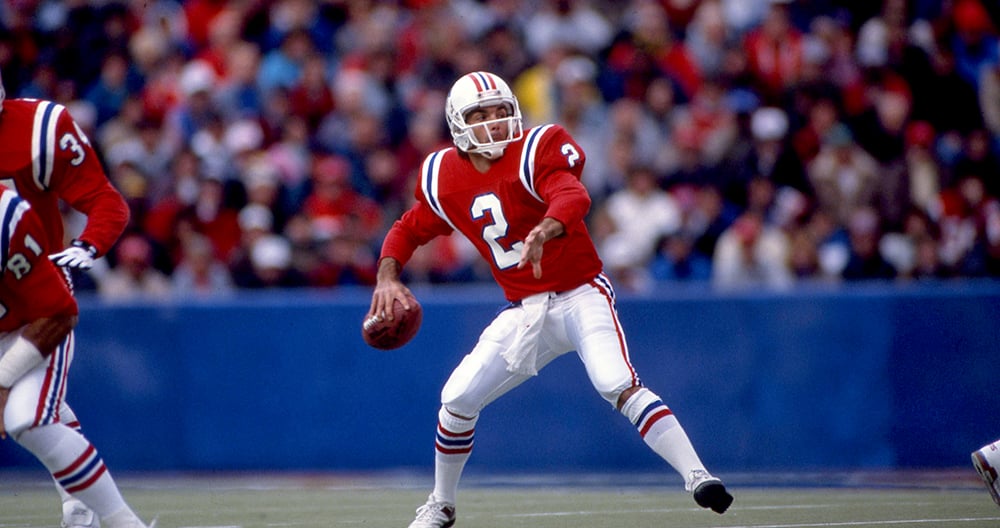
Flutie was traded to the New England Patriots in 1987 during the NFL players strike. Crossing the picket line for an opportunity to play, he saw limited action that season, appearing in one game – a 21-7 victory over the Houston Oilers, where he completed 15 of 25 passes for 199 yards, one touchdown and zero interceptions.
In 1988, Flutie made a dramatic return.
Coming off the bench in Week 5, he led a thrilling comeback victory over the Indianapolis Colts in Foxborough, sealing the game with a 13-yard bootleg touchdown in the final moments of the fourth quarter. He went on to guide the Patriots to a 6-3 record as a starter that season, highlighted by a four-touchdown, zero-interception performance against his former team, the Chicago Bears, who once again boasted the league’s top-ranked scoring defense. The Patriots won convincingly, 30-7.
Despite his success, head coach Raymond Berry made the surprising decision to bench Flutie late in the season in favor of Tony Eason. The move proved costly, as the Patriots lost their final game against the Denver Broncos, 21-10 and were eliminated from playoff contention due to a tiebreaker.
What could have marked the end of Flutie’s professional football journey instead ignited one of the sport’s most prolific second acts. In 1990, he signed with the BC Lions of the Canadian Football League (CFL), launching an unprecedented run of dominance that would reshape the league’s record books and redefine quarterback play north of the border.
In his second season with the Lions, 1991, Flutie set a CFL single-season record by throwing for 6,619 – a mark that still stands. That campaign earned him his first CFL Most Outstanding Player (MOP) award, an honor he would claim a record six times (1991-94, 1996-1997). Remarkably, he won the league’s most prestigious honor in four consecutive seasons playing with two different teams.
Flutie joined the Calgary Stampeders in 1992 and didn’t miss a beat. He passed for 6,092 yards, becoming the only quarterback in CFL history to eclipse the 6,000-yard mark with two franchises, and led Calgary to a 24-10 victory over the Winnipeg Blue Bombers in the 80th Grey Cup. He was named Grey Cup MVP for his performance, securing Calgary’s first championship since 1971. In 1994, Flutie set another CFL single-season record that hasn’t been touched: 48 touchdown passes.
In 1996, Flutie joined the Toronto Argonauts and again made an immediate impact. He led the Argos to consecutive championships, earning Grey Cup MVP honors in both games, as well as back-to-back Most Outstanding Player awards. In 1997, Flutie threw 47 touchdown passes – the second-highest total in CFL history, surpassed only by his own mark set in 1994.
Only one mountain was left to (re-)climb: the National Football League.
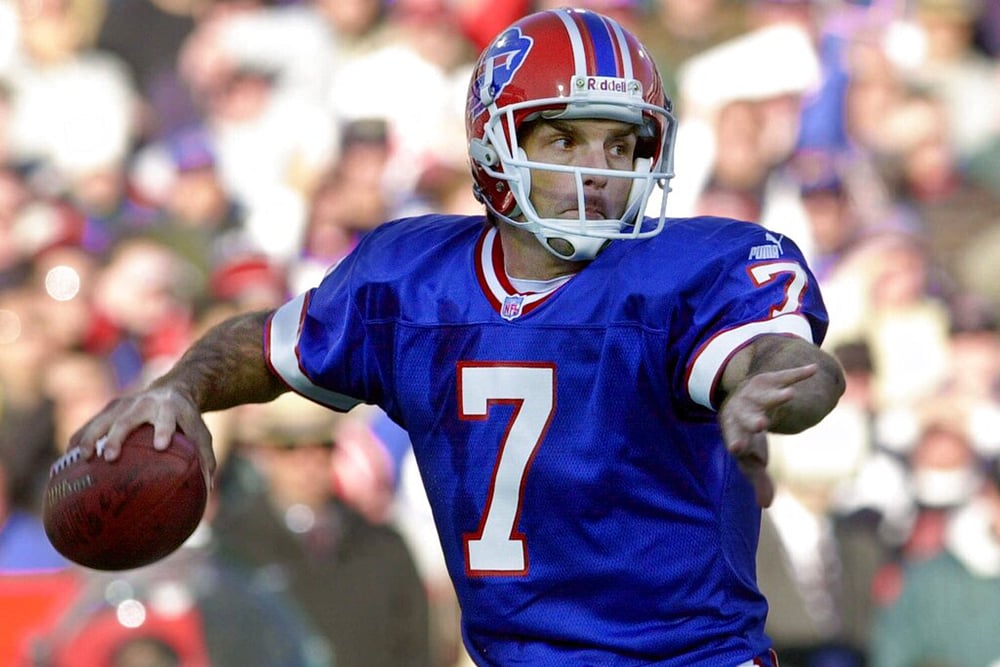
Flutie returned to the National Football League in 1998, signing with the Buffalo Bills. In the season opener against the San Diego Chargers, Flutie came off the bench after starting quarterback Rob Johnson sustained an injury. He made an immediate impact, completing 12 of 20 passes for 158 yards, two touchdowns, one interception and a 97.5 passer rating – enough to generate buzz in Buffalo about his potential.
That buzz erupted into full-blown Flutie-Mania during the Bills’ Week 6 matchup against Peyton Manning and the Indianapolis Colts. With Johnson again sidelined by injury, Flutie stepped in and delivered a masterclass performance, completing 23 of 28 passes for 213 yards, two touchdowns, zero interceptions and a 122.2 passer rating to lead Buffalo to a 31-24 victory over their AFC East rival.
From that moment, Flutie was firmly entrenched as the Bills’ starting quarterback. Including the win over Indianapolis, he guided the team to an 8-3 record down the stretch, securing a playoff berth and reigniting hope in Buffalo. For his outstanding performance and leadership, Flutie was selected to the Pro Bowl and named the NFL’s Comeback Player of the Year, capping off one of the most remarkable resurgences the league had seen.
During his three-year run in Buffalo, Flutie led the Bills to a 21-9 record. To put the scope of that 70 percent win rate into perspective (and noting the modest sample size), he produced a comparable winning percentage to JOE MONTANA'S run with the San Francisco 49ers (100-39: 71.9%), TERRY BRADSHAW'S run with the Pittsburgh Steelers (107-51, 67.7%) and PEYTON MANNING'S run with the Colts (141-67, 67.8%).
In 2001, at age 39, Flutie signed with the San Diego Chargers and began the season as the team’s starting quarterback. He showcased flashes of brilliance, producing a higher passer rating than a young Tom Brady (99.7 to 93.4) during a narrow 29-26 overtime loss to the New England Patriots. Through the first seven games, Flutie led the Chargers to a 5-2 record, with no margin of loss exceeding four points. However, an 0-9 slide to close out the season marked the end of his tenure as a full-time starter.
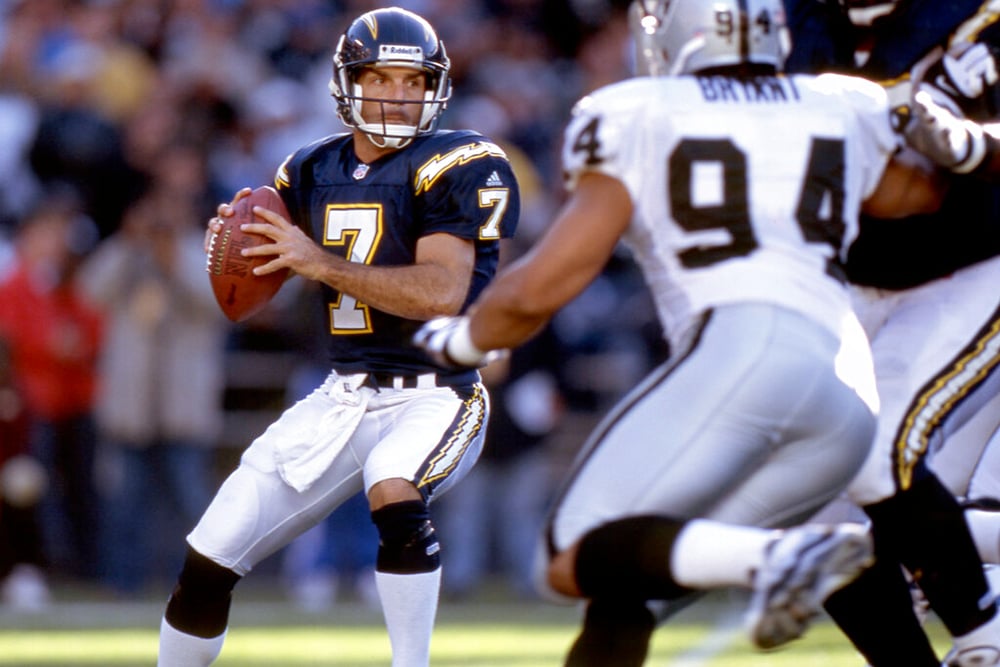
During his four-year run in San Diego, Flutie served as a mentor to a young Drew Brees. Flutie (5-foot-11) could relate to Brees (6-foot), the latter deemed “too short” by many scouts to warrant a first-round draft pick.
“If you would've asked me prior to me getting drafted, growing up through high school and college, who I tried to emulate or was the most similar to in regard to my playing style or who I was trying to be, I would've said Doug Flutie,” Brees told Colin Cowherd in 2021.
“Not only was I short, but I came in the league behind a guy named Doug Flutie, who, in my opinion, is one of the greatest quarterbacks in all of professional football. He played every level of it: from the USFL to the CFL to the NFL,” Brees said in a recent interview on "The Dan Patrick Show." “He was doing things that were ahead of his time, and I don’t think he gets the appreciation for it. He was Patrick Mahomes before Patrick Mahomes. Everything you see Mahomes do, I saw Flutie do every day in practice – from the no-look throws to the back-shoulder throws to manipulating defenders with his eyes, buying time.”
Brees said recently, his “Mount Rushmore of NFL quarterbacks” includes Bradshaw, Brady, Montana and Flutie.
Though Brees’ style was less mobile than Flutie’s, the influence Flutie had on Brees’ development and eventual ascension to elite status was undeniable. Much like Flutie in 1998, Brees was selected to his first Pro Bowl and named NFL Comeback Player of the Year in 2004 – backed by Flutie, still serving as mentor, in the quarterback room.
In 2005, Flutie returned to the New England Patriots to serve the team as Tom Brady’s backup. Although his on-field action was limited – 10 pass attempts all season – he delivered one of the most memorable moments of his career in the regular-season finale against the Miami Dolphins.
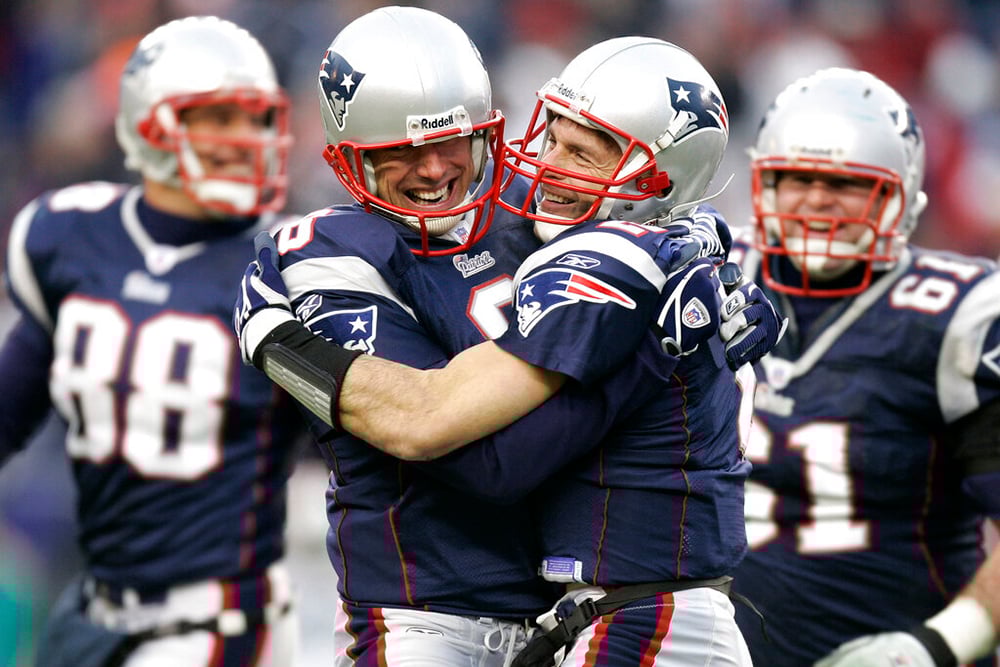
Flutie successfully executed a drop kick for an extra point, becoming the first player to do so in an NFL game since 1941. For this feat, he was named AFC Special Teams Player of the Week. To date, no other player has successfully completed a drop kick, making Flutie’s attempt the only one of its kind in the modern era – a fitting capstone to his remarkable professional football career.
His dominance at Boston College and in the CFL saw him elected to the College Football Hall of Fame in 2007 and the Canadian Football Hall of Fame in 2008.
Although USFL and CFL statistics are not officially recognized alongside NFL records, the full scope of Doug Flutie's professional football career is staggering. Over 21 seasons across three leagues, passing and rushing combined and including the postseason, Flutie amassed 70,332 total yards (2,574 in the USFL, 50,874 in the CFL and 16,884 in the NFL) and produced 475 total touchdowns (19 in the USFL, 358 in the CFL and 98 in the NFL).
It’s worth noting that the two quarterbacks Flutie mentored during the final five seasons of his career, Brees and Brady, went on to become the NFL’s top two all-time leaders in completions, passing yards and touchdown passes.
From a miraculous college play forever etched in football lore, to his pioneering dominance in the CFL, to an improbable and redemptive resurgence in the NFL, Flutie’s journey serves as a blueprint for overcoming adversity and thriving through unconventional paths. Despite setbacks and doubts, he refused to be defined by failure, and in the end he left the game on his own terms, with a career that outlasted doubt and exceeded expectations.
Ryan Michael is a sportswriter, a statistician for KOA’s “Broncos Country Tonight” and a contributor to the Pro Football Hall of Fame. You can follow him on X (@theryanmichael) and on “Broncos Country Tonight”.
This article is the latest in an ongoing series highlighting noteworthy quarterback play over the past 80 seasons. Information from Pro-Football-Reference.com’s database helped make the research possible.
Special to the Pro Football Hall of Fame
(Editor’s note: This article is the latest in an ongoing series looking at quarterbacks’ achievements that have aged well over the past 80 NFL seasons.)
Doug Flutie’s football career defied conventional boundaries, spanning three leagues, two countries and more than two decades of memorable moments, improbable comebacks and record-shattering performances.
From his legendary “Hail Mary” at Boston College to rewriting the record books in the Canadian Football League – and ultimately engineering a remarkable NFL resurgence in his late 30s – Flutie’s path was anything but traditional.
Undersized, underestimated and often overlooked, he rose time and again to deliver when it mattered most. He left behind not only a staggering statistical legacy, but also a blueprint for perseverance, creativity and resilience in the unpredictable and often unforgiving world of professional football.
That journey began in earnest at Boston College, where Flutie’s four-year tenure reached its pinnacle in 1984, when he captured the Heisman Trophy following a standout senior season. In one of college football’s most iconic moments, with seconds remaining on the clock, Flutie rolled to his right and launched a 63-yard “Hail Mary” pass into the end zone. Against all odds, the ball connected with wide receiver Gerard Phelan, securing a dramatic 47-45 victory over the Miami Hurricanes in the Orange Bowl.
Flutie concluded his collegiate career with 677 completions for 10,579 yards and 67 touchdowns.
Act I: From the USFL to the NFL
Flutie’s professional football career began not in the NFL but in the now-defunct United States Football League (USFL). In 1985, he signed a landmark five-year, $7 million contract with Donald Trump’s New Jersey Generals, making him the highest-paid player in professional football at the time across any league.His professional debut came in February 1985 against the Orlando Renegades, a highly anticipated moment that fell well short of expectations. His first two professional passes were intercepted, and he ended the game without producing a touchdown. Despite the rocky start to the season, Flutie eventually showed flashes of the dynamic playmaking that defined his Boston College career.
Over 15 games, he completed 134 of 281 passes for 2,109 yards and 13 touchdowns. Unfortunately, his rookie campaign – and his USFL career – was cut short by injury. The league itself folded the following year, bringing an abrupt end to the first chapter of his professional football career.
Flutie was selected in the 11th round of the 1985 NFL Draft by the Los Angeles Rams but never played for the team. In 1986, he landed with the Chicago Bears after they traded multiple draft picks for his rights.
Following an injury to starting quarterback Jim McMahon, Flutie was thrust into the spotlight, starting the 1986 divisional playoff against the Washington Redskins. The results weren’t pretty; Flutie completed 11 of 31 passes for 134 yards, one touchdown, two interceptions and a 33.5 passer rating. The Bears lost 27-13, marking the end of his brief time in Chicago.
Flutie was traded to the New England Patriots in 1987 during the NFL players strike. Crossing the picket line for an opportunity to play, he saw limited action that season, appearing in one game – a 21-7 victory over the Houston Oilers, where he completed 15 of 25 passes for 199 yards, one touchdown and zero interceptions.
In 1988, Flutie made a dramatic return.
Coming off the bench in Week 5, he led a thrilling comeback victory over the Indianapolis Colts in Foxborough, sealing the game with a 13-yard bootleg touchdown in the final moments of the fourth quarter. He went on to guide the Patriots to a 6-3 record as a starter that season, highlighted by a four-touchdown, zero-interception performance against his former team, the Chicago Bears, who once again boasted the league’s top-ranked scoring defense. The Patriots won convincingly, 30-7.
Despite his success, head coach Raymond Berry made the surprising decision to bench Flutie late in the season in favor of Tony Eason. The move proved costly, as the Patriots lost their final game against the Denver Broncos, 21-10 and were eliminated from playoff contention due to a tiebreaker.
Act II: The CFL
What could have marked the end of Flutie’s professional football journey instead ignited one of the sport’s most prolific second acts. In 1990, he signed with the BC Lions of the Canadian Football League (CFL), launching an unprecedented run of dominance that would reshape the league’s record books and redefine quarterback play north of the border.In his second season with the Lions, 1991, Flutie set a CFL single-season record by throwing for 6,619 – a mark that still stands. That campaign earned him his first CFL Most Outstanding Player (MOP) award, an honor he would claim a record six times (1991-94, 1996-1997). Remarkably, he won the league’s most prestigious honor in four consecutive seasons playing with two different teams.
Flutie joined the Calgary Stampeders in 1992 and didn’t miss a beat. He passed for 6,092 yards, becoming the only quarterback in CFL history to eclipse the 6,000-yard mark with two franchises, and led Calgary to a 24-10 victory over the Winnipeg Blue Bombers in the 80th Grey Cup. He was named Grey Cup MVP for his performance, securing Calgary’s first championship since 1971. In 1994, Flutie set another CFL single-season record that hasn’t been touched: 48 touchdown passes.
In 1996, Flutie joined the Toronto Argonauts and again made an immediate impact. He led the Argos to consecutive championships, earning Grey Cup MVP honors in both games, as well as back-to-back Most Outstanding Player awards. In 1997, Flutie threw 47 touchdown passes – the second-highest total in CFL history, surpassed only by his own mark set in 1994.
Only one mountain was left to (re-)climb: the National Football League.
Act III: Return to the NFL
Flutie returned to the National Football League in 1998, signing with the Buffalo Bills. In the season opener against the San Diego Chargers, Flutie came off the bench after starting quarterback Rob Johnson sustained an injury. He made an immediate impact, completing 12 of 20 passes for 158 yards, two touchdowns, one interception and a 97.5 passer rating – enough to generate buzz in Buffalo about his potential.
That buzz erupted into full-blown Flutie-Mania during the Bills’ Week 6 matchup against Peyton Manning and the Indianapolis Colts. With Johnson again sidelined by injury, Flutie stepped in and delivered a masterclass performance, completing 23 of 28 passes for 213 yards, two touchdowns, zero interceptions and a 122.2 passer rating to lead Buffalo to a 31-24 victory over their AFC East rival.
From that moment, Flutie was firmly entrenched as the Bills’ starting quarterback. Including the win over Indianapolis, he guided the team to an 8-3 record down the stretch, securing a playoff berth and reigniting hope in Buffalo. For his outstanding performance and leadership, Flutie was selected to the Pro Bowl and named the NFL’s Comeback Player of the Year, capping off one of the most remarkable resurgences the league had seen.
During his three-year run in Buffalo, Flutie led the Bills to a 21-9 record. To put the scope of that 70 percent win rate into perspective (and noting the modest sample size), he produced a comparable winning percentage to JOE MONTANA'S run with the San Francisco 49ers (100-39: 71.9%), TERRY BRADSHAW'S run with the Pittsburgh Steelers (107-51, 67.7%) and PEYTON MANNING'S run with the Colts (141-67, 67.8%).
In 2001, at age 39, Flutie signed with the San Diego Chargers and began the season as the team’s starting quarterback. He showcased flashes of brilliance, producing a higher passer rating than a young Tom Brady (99.7 to 93.4) during a narrow 29-26 overtime loss to the New England Patriots. Through the first seven games, Flutie led the Chargers to a 5-2 record, with no margin of loss exceeding four points. However, an 0-9 slide to close out the season marked the end of his tenure as a full-time starter.
During his four-year run in San Diego, Flutie served as a mentor to a young Drew Brees. Flutie (5-foot-11) could relate to Brees (6-foot), the latter deemed “too short” by many scouts to warrant a first-round draft pick.
“If you would've asked me prior to me getting drafted, growing up through high school and college, who I tried to emulate or was the most similar to in regard to my playing style or who I was trying to be, I would've said Doug Flutie,” Brees told Colin Cowherd in 2021.
“Not only was I short, but I came in the league behind a guy named Doug Flutie, who, in my opinion, is one of the greatest quarterbacks in all of professional football. He played every level of it: from the USFL to the CFL to the NFL,” Brees said in a recent interview on "The Dan Patrick Show." “He was doing things that were ahead of his time, and I don’t think he gets the appreciation for it. He was Patrick Mahomes before Patrick Mahomes. Everything you see Mahomes do, I saw Flutie do every day in practice – from the no-look throws to the back-shoulder throws to manipulating defenders with his eyes, buying time.”
Elite company for Doug Flutie
Brees said recently, his “Mount Rushmore of NFL quarterbacks” includes Bradshaw, Brady, Montana and Flutie.Though Brees’ style was less mobile than Flutie’s, the influence Flutie had on Brees’ development and eventual ascension to elite status was undeniable. Much like Flutie in 1998, Brees was selected to his first Pro Bowl and named NFL Comeback Player of the Year in 2004 – backed by Flutie, still serving as mentor, in the quarterback room.
In 2005, Flutie returned to the New England Patriots to serve the team as Tom Brady’s backup. Although his on-field action was limited – 10 pass attempts all season – he delivered one of the most memorable moments of his career in the regular-season finale against the Miami Dolphins.
Flutie successfully executed a drop kick for an extra point, becoming the first player to do so in an NFL game since 1941. For this feat, he was named AFC Special Teams Player of the Week. To date, no other player has successfully completed a drop kick, making Flutie’s attempt the only one of its kind in the modern era – a fitting capstone to his remarkable professional football career.
His dominance at Boston College and in the CFL saw him elected to the College Football Hall of Fame in 2007 and the Canadian Football Hall of Fame in 2008.
Although USFL and CFL statistics are not officially recognized alongside NFL records, the full scope of Doug Flutie's professional football career is staggering. Over 21 seasons across three leagues, passing and rushing combined and including the postseason, Flutie amassed 70,332 total yards (2,574 in the USFL, 50,874 in the CFL and 16,884 in the NFL) and produced 475 total touchdowns (19 in the USFL, 358 in the CFL and 98 in the NFL).
It’s worth noting that the two quarterbacks Flutie mentored during the final five seasons of his career, Brees and Brady, went on to become the NFL’s top two all-time leaders in completions, passing yards and touchdown passes.
From a miraculous college play forever etched in football lore, to his pioneering dominance in the CFL, to an improbable and redemptive resurgence in the NFL, Flutie’s journey serves as a blueprint for overcoming adversity and thriving through unconventional paths. Despite setbacks and doubts, he refused to be defined by failure, and in the end he left the game on his own terms, with a career that outlasted doubt and exceeded expectations.
Ryan Michael is a sportswriter, a statistician for KOA’s “Broncos Country Tonight” and a contributor to the Pro Football Hall of Fame. You can follow him on X (@theryanmichael) and on “Broncos Country Tonight”.
This article is the latest in an ongoing series highlighting noteworthy quarterback play over the past 80 seasons. Information from Pro-Football-Reference.com’s database helped make the research possible.
More of this series
- Analysis: Charlie Conerly’s giant accomplishments hold up as eras pass
- Y.A. Tittle’s journey from San Francisco to New York
- Analysis: An appreciation of Sammy Baugh’s historic 1943 season
- Legendary seasons for Sid Luckman, Peyton Manning separated by 70 years
- Looking back at TB12’s historic 2011 season 12 years later
- Russell Wilson’s decade of dominance in Seattle remains elite
- Roger Staubach’s 1971: The greatest season you’ve never heard about
- Silver anniversary: Randall Cunningham’s solid gold season with Vikings
- 50 years since Unitas’ last pass: Some things you might not know about No. 19
- Race to the top: Brady’s battle with Brees for the NFL’s most hallowed record
- Analysis: Did Andrew Luck exceed hype or fall short?
- Silver anniversary of John’s Elway’s sterling final game
- As cold as ice: Perception of Matt Ryan’s legacy after ‘28-3’
- Cam Newton leads high-flying 2015 Carolina Panthers
- Peyton Manning’s four-year rodeo in Mile High City
- Dan Marino eclipsed long-standing TD record 40 years ago
- Analysis: Quarterbacking excellence can continue after Big 4-0
- Matthew Stafford’s career arc placing him among game’s elite
- From Montreal to Buffalo: Marv Levy’s pursuit of victory
- Doug Flutie: From magic to mentor
- Analysis: Joe Flacco further evolving Bengals’ prolific passing attack
Previous Article
Antonio Gates to receive Pro Football Hall of Fame Ring of Excellence
The Pro Football Hall of Fame and KAY Jewelers, the Official Provider of the Pro Football Hall of Fame Ring of Excellence, will honor Class of 2025 member Antonio Gates during a special ceremony Sunday, Oct. 19.
Next Article
Eric Allen to receive Pro Football Hall of Fame Ring of Excellence
The Pro Football Hall of Fame and KAY Jewelers, the Official Provider of the Pro Football Hall of Fame Ring of Excellence, will honor Class of 2025 member Eric Allen during a special ceremony Sunday, Oct. 12.