Moments in NFL Draft History: Steelers draft way to 1970s dynasty run

“The 2026 NFL Draft is officially open. The Las Vegas Raiders are on the clock.”
Commissioner Roger Goodell will utter these words as he officially kicks off the 2026 National Football League Draft in Pittsburgh. This year’s draft will be full of chalk picks, long-shot odds, surprising trades and the start of more than 250 football careers. The focus Thursday night will be on that.
The host city and its NFL franchise have their own story to tell…
Any list of “best NFL draft years” will include 1983 (nine Hall of Famers), 1981 (seven Hall of Famers) and 1964 (a record 10 Hall of Famers). Also mentioned frequently: the 1974 NFL Draft, and while it did not produce a record for most Hall of Famers (a modest six selected), it concluded one of the most impressive draft runs by an NFL team.
From 1969 through 1974, the Pittsburgh Steelers drafted nine future members of the Pro Football Hall of Fame. Another future enshrinee signed as an undrafted free agent. A Hall of Fame owner, general manager, head coach and assistant director of player personnel were running things behind the scenes.
Until 1972, the Steelers had made one lone playoff appearance, in 1947, that resulted in a 21-0 loss to the Philadelphia Eagles to determine the East Division champion. The beginning of a vast organizational change came in 1967, when then-owner ART ROONEY SR. hired a sportswriter from the Pittsburgh Courier whose main piece of work each year was developing a Black College All-America team. His name: BILL NUNN.
“That was the only exposure that the players from the black schools got,” Nunn said in a 2010 interview with Steelers.com that coincided with his election in the inaugural class of the Black College Football Hall of Fame. “We would have a banquet in Pittsburgh and bring the guys to Pittsburgh and have the Black national champion, player of the year, coach of the year.”
Nunn’s work as a scout – and later assistant director of player personnel – was the start of something special in the Steel City. But like every team, one person or one move can’t change a franchise, but it can get the ball rolling.
The next step? Finding the right person to lead a team of men, a team that from its only playoff appearance until 1969 had posted only five winning seasons. The man for that job was CHUCK NOLL. Noll, who had played under Hall of Fame coach PAUL BROWN, got into coaching immediately after his playing career ended. After nine seasons spent as an assistant, Art Rooney and his son DAN ROONEY, the general manager at the time, decided Noll was the right guy for the job.
“He [Noll] came highly recommended by football scouts and assistant coaches in the League, as well as Baltimore head coach DON SHULA, and he had a reputation as a knowledgeable player and a focused coach,” stated Anne Madarasz, chief historian and director of the Franco Harris Sports Museum at the Heinz History Center, in a recent interview with the Hall of Fame. “Dan Rooney took the lead on the hire, and I think he liked Noll’s desire to do two things: build a team of smart, coachable athletes and use the draft to do it.”
But it wasn’t Noll by himself.
“I think Coach Noll understood and appreciated Bill Nunn’s knowledge and experience scouting HBCU players and saw right away the impact they could make on the team,” Madarasz said. “They had mutual respect and a commitment to building a championship team together.”
“This combination became the cornerstone of the franchise’s amazing success in the 1970s,” said Joe Horrigan, a football historian, author and longtime member of the Hall of Fame’s staff. “Key personnel behind the masterful draft strategy that focused on finding untapped talent at Historically Black College and Universities and hidden gems from smaller schools.”
The front office was aligned with the team on the field; now it was time for them to build something special.
First key pick
That movement started Jan. 28, 1969. The Steelers held the fourth overall pick in the draft, and the defensive side of the ball was their focus. They selected a 6-foot-4, 275-pound defensive linemen out of North Texas State who would become the anchor of the team’s dynastic run.
JOE GREENE played a major role in the team’s success, ultimately winning two Defensive Player of the Year awards. His later accolades would include status as a four-time first-team All-Pro selection and member of both the NFL’s All-Decade Team of the 1970s and NFL 100 All-Time Team. In addition to his on-field skills, he served as the leader the team needed.
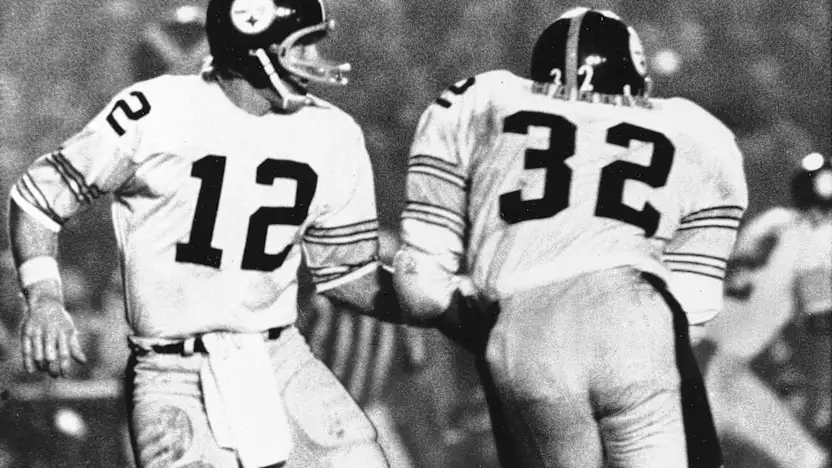
One draft later, the Steelers added two more foundational pieces – both from the Bayou. TERRY BRADSHAW, the first overall selection out of Louisiana Tech, and MEL BLOUNT, the 53rd overall selection out of Southern, came to Pittsburgh to help lift the organization to new heights. Bradshaw, who started eight games his rookie season, went on to win NFL MVP honors in 1978. Blount, a player so dominant a rule is named after him, was a gamechanger at defensive back, and his play earned him Defensive Player of the Year in 1975.
The Steelers had their leader at quarterback and two lynchpins on defense and started to see a glimmer of success. The organization went from a point differential of minus-186 in 1969 to minus-62 in 1970. In 1971, the team added one more piece to solidify the defense, selecting Penn State linebacker JACK HAM in the second round (34th overall), giving the Steelers future Hall of Famers at all three levels of the defense. Ham, who made an immediate impact, started 13 of 14 games and received Rookie of the Year votes.
The defense was solid. It was time to add an “elemento rivoluzionario” on offense.
The Steelers went back to the mountains in Happy Valley in 1972 and selected running back FRANCO HARRIS with the 13th overall pick. Harris, whose “Immaculate Reception” in the Divisional Round of the playoffs would win the Steelers their first playoff game in nearly 30 years, became synonymous with Pittsburgh and the Steelers’ organization, becoming a fan favorite of the Steeler faithful.
“Franco’s Italian Army” – Franco’s own personal cheering section – was born to support the rookie running back his first year in Pittsburgh in 1972, and you can still see T-shirts with that moniker roaming Acrisure Stadium on a Sunday afternoon.
“Everything changed when the Steelers drafted Franco!” Mel Blount’s words echoed what the entire Steel City was feeling. And while the draft in 1973 did not produce a future Hall of Famer for the organization, it did yield three players who would become starters for four or more years.
Then comes 1974
Jan. 29, 1974, is a day most Steelers fans know represents the culmination of the previous five seasons’ of moves, hires and drafts that would shift a football dynasty into its top gear.
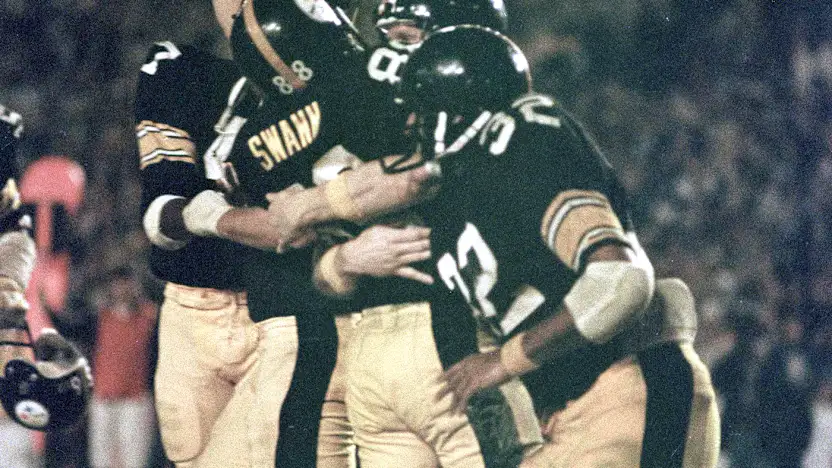
Regarded as possibly the best draft by any franchise in NFL history, the Steelers selected four future Hall of Famers with their first five selections: LYNN SWANN, the quick, soft-handed receiver out of USC with the 21st overall selection; JACK LAMBERT, the undersized but hard-nosed, unknown prospect out of Kent State with the 46th overall pick; JOHN STALLWORTH, whom Nunn scouted more than other scouts in the NFL out of Alabama A&M with the 82nd overall pick; and MIKE WEBSTER, or “Iron Mike” as he would become to be known, out of Wisconsin with the 125th overall pick.
To, as they might say in Pittsburgh, “keep the molten metal boiling,” the Steelers signed DONNIE SHELL as an undrafted free agent out of South Carolina State. These five individuals combined to play in more than 850 games and helped lead the team on its historic run.
“In catching the go-ahead touchdown versus the Raiders in the AFC Championship Game, I proved that pass receptions could be vital in the big games for the Steelers,” Swann said in a recent interview with the Hall of Fame. He had a knack for making those plays, many in pivotal moments.
But it wasn’t only the team’s play on the field that led to its success.
“The Rooney family really believed in faith, family, football and community. They were really good people,” Shell told the Hall of Fame. “They didn't just talk about these things, they lived it before our very eyes – every day. It had a tremendous impact on us as players and as families. Our team not only had great players, but they were great people. Just like the Rooney family.”
The Steelers’ franchise epitomized what it was like for a front office to be connected to its staff, coaches and players.
After making (and winning) a playoff game in 1972, the Steelers made the playoffs each of the next seven seasons – highlighted by winning the Super Bowl four times. According to Pro Football Reference’s “Approximate Value Average,” over those seven seasons, Greene, Harris, Lambert, Bradshaw and Webster had the highest value on the team while Swann and Stallworth both had seasons leading the team in receiving. Ham and Shell were big contributors as well, earning nine total Pro Bowls and seven first-team All-Pro nominations between them.
“Terrible Towel” enthusiasts rejoiced and got to see something few NFL fans ever get to see. Fourteen Hall of Famers had a hand in turning around the franchise. Without any one of those 14, this legendary story might have ended much differently.