The Tight End Trend

Once nonexistent and now absolutely essential, the tight end position is an example of football innovation at it’s finest
By Craig Ellenport
Special to the Pro Football Hall of Fame
When the Pro Football Hall of Fame welcomed its first class in 1963, there were no tight ends among the enshrinees. That same story would repeat itself for the next two dozen years.
Yet, that void is not as crazy as it might sound. After all, tight end was still a pretty new position in 1963. Even in the late 1970s, when Hall of Fame tight end KELLEN WINSLOW came on the scene, it took him awhile to grasp not only the subtleties of the game, but the position he was playing.
“I didn’t understand football,” Winslow said, “until I realized it was chess.”
Winslow didn’t start playing football until his senior year in high school. That season and into his freshman year at Missouri, he admits he was “just out there running around.” Soon after, however, Winslow began visualizing the gridiron like a chess board. And he saw the tight end as being perhaps the most unique chess piece when it came to movement and responsibility.
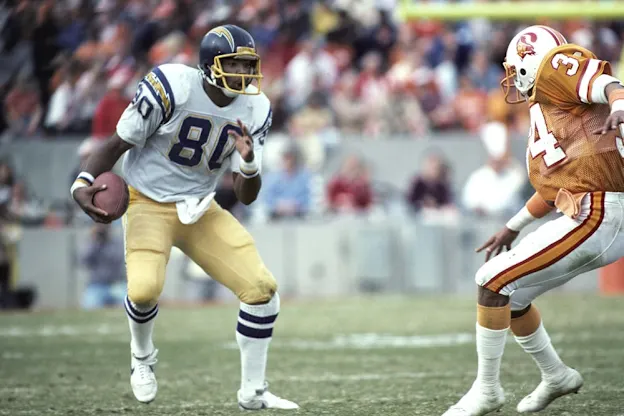
“When I realized that I was like a knight in chess, I said, ‘OK now this makes sense.’ ”
Just as the knight is unique among pieces in the way it moves across the board, so, too, is the tight end on a football field. The tight end “controls the middle of the field,” Winslow explained.
Winslow is among a small group of tight ends who have achieved Hall of Fame status. His fellow Chargers alum, ANTONIO GATES, became the 10th member of this elite fraternity when he was enshrined in Canton this past summer.
Similar to Winslow and the other eight tight ends in the Hall, Gates combined size, speed, athleticism and smarts to become one of the most dangerous offensive weapons of his era. Gates’ primary attribute was his ability to be an effective red-zone target, and his 116 career touchdown receptions remain a record for the position.
The concept of the tight end began taking shape in the 1940s, when teams embraced the two-platoon system and thus had the flexibility to be more creative. Offenses would line up one receiver (or split end) far from the line. On the other side, a flanker or fullback might line up close to the offensive line, thus becoming the tight end. This would be the strong side, with an extra blocker for running plays. But, by rule, the tight end could also go downfield to catch passes.
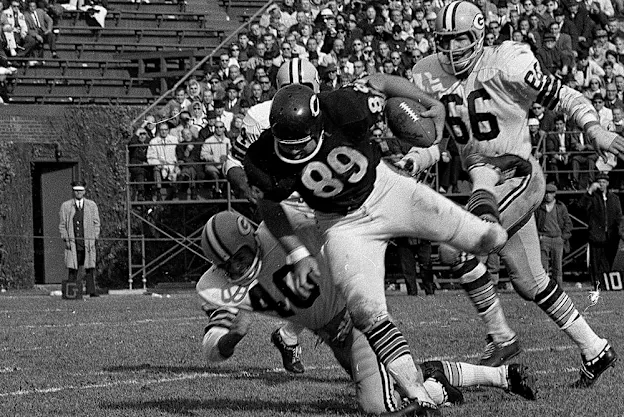
Yet it wasn’t until 1961 that a player would come along to define the position. Not redefine … define. That was MIKE DITKA. The Chicago Bears’ first-round pick in 1961, Ditka immediately posted numbers never seen by a tight end: 56 receptions, 1,076 yards, 12 touchdowns. All three were records for a rookie tight end. In 1964, he caught 75 passes, setting a single-season mark for a tight end that stood until Winslow caught 89 in 1980.
“Ditka’s numbers are incredible considering what the position was at that time,” Winslow said.
In 1988, Ditka became the first tight end elected to the Hall of Fame. The second was JOHN MACKEY, a contemporary of Ditka’s. While Ditka was more of a bruiser with the football in his hands, Mackey’s claim to fame was his speed. The Colts star averaged 18.9 yards per catch over his first four seasons, and in 1966 scored six touchdowns of 51 or more yards.
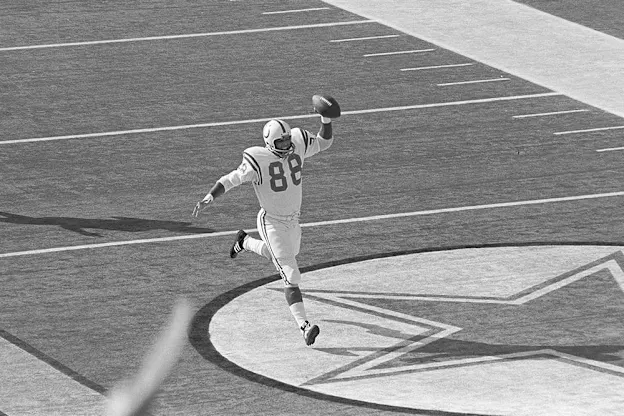
More elite tight ends followed, including future Hall of Famers **JACKIE SMITH, CHARLIE SANDERS, DAVE CASPER**and OZZIE NEWSOME. But it was the emergence of Winslow in the Chargers’ high-powered passing attack that opened everyone’s eyes to what a tight end could do.
What made Winslow so dangerous?
“Well, obviously the physical part of it,” said Hall of Fame quarterback DAN FOUTS, who had the benefit of throwing to Winslow. “And he was smart. We asked him to do a lot of things, and I don’t think he ever made a mistake. I don’t think he ever blew an assignment. And, you know, after the catch, his toughness was evident.”

While Ditka and Mackey were the first tight ends to put up big receiving numbers, Winslow set new standards. He had at least 88 catches for at least 1,075 yards in three of his first five NFL seasons. Still, if you ask Winslow about his place in the evolution of tight ends, he’s quick to say he was in the right place at the right time … with the right coach.
“I’ve heard people say that I changed the tight end position,” he said. “I had nothing to do with that. That was DON CORYELL.”
Coryell, who joined Fouts and Winslow in the Hall of Fame two years ago, became head coach of the Chargers in 1978, a year before Winslow was drafted. With the likes of Fouts, Winslow and receivers John Jefferson and CHARLIE JOINER, the Chargers’ offense became known as “Air Coryell,” amassing otherworldly passing numbers.
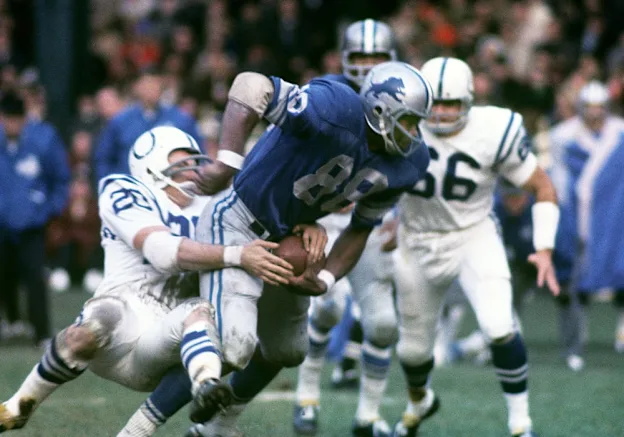
“I happened to be the tight end who was there with Don Coryell when they did that,” Winslow said. “There were a lot of guys before me who could have done the same thing, but they didn’t play for Don Coryell. He took out the fullback and put in two tight ends. Now you have two people who can block and can catch the ball. It just created mismatches. And with a smart quarterback like Dan Fouts, we could take advantage of those mismatches.”
Fouts praised Winslow’s ability to post up a defender and shield him away from the ball. Winslow himself referred to it as “boxing out” defenders. And it’s no coincidence that basketball terminology would be used to describe elite tight end play.
After all, Hall of Fame tight end TONY GONZALEZ, who holds the position’s all-time records for catches and yards, was a two-sport star at Cal, playing football and basketball. Gates, however, never played football in college; he was a power forward at Kent State before signing with the Chargers as an undrafted free agent.

“They wanted people with decent footwork,” Winslow said of tight end prospects. “That’s why so many guys who played the tight end position then and now were basketball players.”
Winslow recalled playing pickup basketball in San Diego with former NBA player Paul Silas, who was head coach of the San Diego Clippers at the time, noting that Silas excelled at boxing out.
“He wasn’t the tallest guy, but he was getting that rebound,” said Winslow. “And that’s what I pretty much did in the middle.”
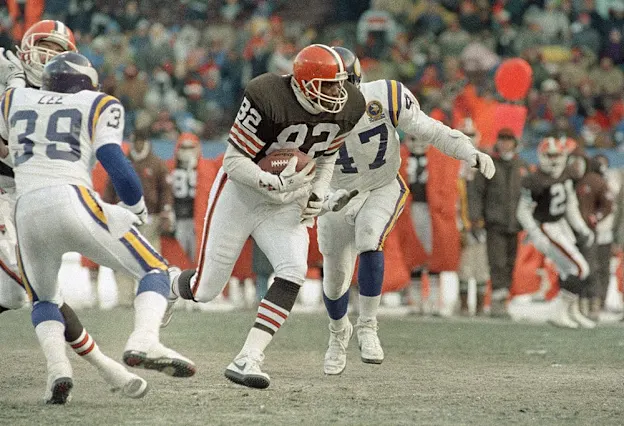
Going back to the chess analogy, Fouts recognized how the Chargers deployed Winslow in different ways based on what the defenses were doing.
“The coaches discovered that he was a mismatch wherever you put him,” Fouts said. “Each week, it would be a new challenge to find the defense’s weakness when it came to Kellen. Put him in motion, see who goes with him; shift him from side to side, see how they adjust.”
Gonzalez, who averaged 46 receptions and 494 yards over his first two NFL seasons, credits Jimmy Raye for unlocking his potential. In his 2019 Hall of Fame acceptance speech, Gonzalez said that Raye, who became the Chiefs’ offensive coordinator in 1998, began “using me in ways that I never knew I could be used, moving me all over the field.”
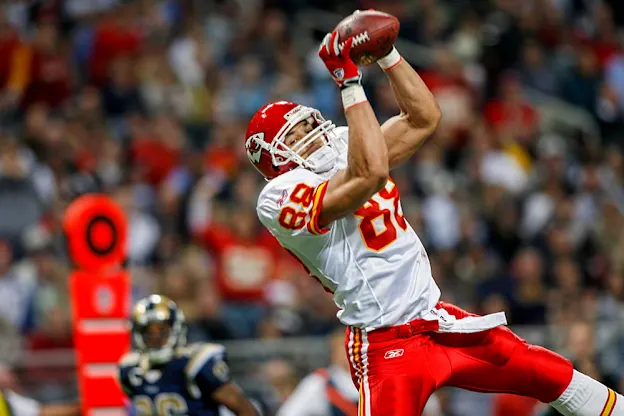
Over the next 10 years, Gonzalez averaged 82 receptions for 995 yards. His 15,127 career yards are not only the best for tight ends, but sixth all-time, regardless of position. His 1,325 career receptions are third behind wide receivers Jerry Rice and Larry Fitzgerald.
While receiving numbers have skyrocketed over the years, most tight ends still take pride in the fact that their job is a combination of receiving and blocking.
“Some may be better at it than others,” Winslow said, “but, yeah, it’s still a part of the job. Sometimes even more critical is the downfield blocking.”
The best tight ends are faster than linebackers and bigger than defensive backs, thus the potential for mismatches. Another case in point: SHANNON SHARPE.

The basketball skills — footwork and boxing out — come into play as well, but the key attribute of a great tight end, says Winslow, is intelligence.
“There’s so many things that are going on,” he explained. “You’re doing so much movement. You have so many different responsibilities, and the ability to conceptualize everything that’s going on and react to it requires a high level of intelligence.”
Strength, speed, footwork, ball skills, intelligence.
“When you’re looking for tight ends in the draft, that’s the model,” Fouts said. “Somebody who’s smart, who’s tough, who’s got great hands, who’s competitive, athletic — all of this.
“And that’s Winslow. And Gonzalez had a lot of those qualities. So did Gates.”

After only six tight ends were enshrined in Canton in the Hall’s first four decades, Gates was the fourth so honored in the last 18 years — with more potentially on the horizon.
Greg Olsen and Jason Witten becomes eligible in 2026; Rob Gronkowski follows in 2027. Travis Kelce stands a good chance to be in the Hall five years after he retires, whenever that might be.
It’s true that there was no such thing as a tight end in football 100 years ago. In today’s game, you can’t win without one.