Moments in NFL History: Origin of ‘the Pennsylvania Polka’
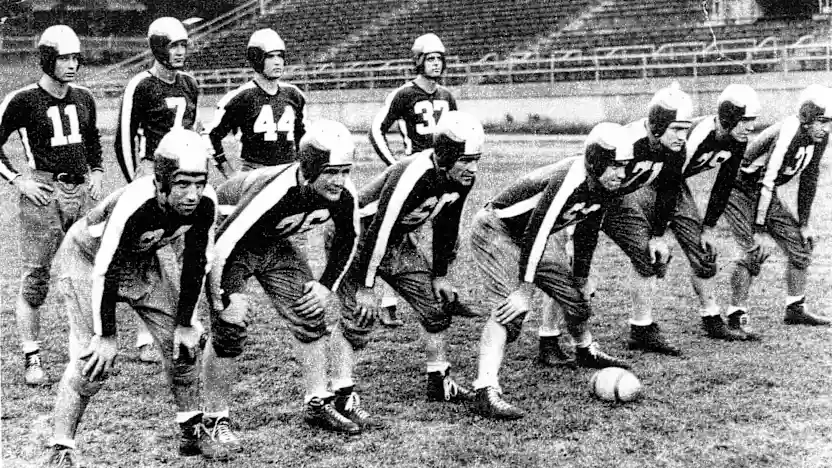
A short time ago, the Pro Football Hall of Fame looked at the Card-Pitts disastrous 1944 season. This wasn’t the first scenario of its kind – two teams coming together in a time of need – to sustain playing pro football the difficult World War II era.
The precursor to the 1944 Card-Pitts? The 1943 Phil-Pitt Steagles.
On this date (June 19) in 1943, the Philadelphia Eagles and the Pittsburgh Steelers came together as the “Steagles.” Officially, they were named the Phil-Pitt Combine, with the “Steagles” moniker coming from local newspapers, first Chet Smith of the Pittsburgh Press.
At the end of the 1943 season, the combination would dissolve, and each team would go back to its respective organization.
The 1943 roster totaled only 30 players, six from the Steelers and 13 from the Eagles. The other members of the team were veterans who came out of retirement, signings from other teams or rookie players – most of whom were military draft exemptees. One future Hall of Famer was one of those veterans: BILL HEWITT, who had retired in 1939, played for the Steagles and was their highest-paid player at $400 per game.
The team was coached by two future Hall of Famers: WALT KIESLING from the Steelers and EARL “GREASY” NEALE from the Eagles.
“First, it sounds insane today to combine two NFL rosters to compete against the rest of the league, but the 1943 Steagles were able to do it. Not only did they do it, but they also actually thrived, finishing the season with a winning record (5-4-1),” said Chris Willis, the head archivist with the National Football League. “[It] takes some mental toughness to be productive and win games … It was an amazing accomplishment.”
This wasn’t the first time these two organizations could’ve become one team.
ART ROONEY dreamed of having one Pennsylvania-based team, playing half of the home games in Pittsburgh and the other half in Philadelphia. Both Pennsylvania organizations were not succeeding on the field – or in their checkbooks. This caused Rooney in 1940 to sell his Pittsburgh organization to 26-year-old Alexis Thompson, who planned to move the team to Boston.
Using the funds from his recently sold franchise, Rooney bought a partnership with BERT BELL and the Eagles. The trio of owners held a mini draft of their signed players to distribute the talent among the two teams. In the end, Rooney-Bell added 11 players to their team from Pittsburgh, and Thompson gained seven players from Philadelphia.


Rooney’s dream of one Pennsylvania team was one step closer to reality – until it wasn’t. Thompson failed to secure a place to play games in Boston, and with Rooney regretting his decision to leave Pittsburgh, decided to throw his version of a “Hail, Mary.”
He and Bell would trade territories with Thompson.
This meant the Rooney-Bell Eagles organization would move to Pittsburgh and play as the Steelers, and Thompson’s newly minted “Ironmen” would move to Philadelphia, playing as the Eagles. Thompson accepted the deal, and the two franchises essentially traded cities, becoming one of the most unusual swaps in sports history.
The story does not end there, of course. As part of the city swap, we get the NFL lore of the “Pennsylvania Polka.”
Essentially, along with the organizations, every player was traded to the other franchise, outside of the players selected in the mini draft. Looking at the NFL Draft in 1941, even more moves occurred. Because the players were drafted prior to swapping cities, the draft picks made by Pittsburgh played in Philadelphia and vice versa.
“The Pennsylvania Polka came at the right time in NFL history. Only two decades old, the league was still trying to be a full-fledged successful sporting league. Only then could something like this happen the way it did,” Willis shared exclusively with the Hall of Fame.
“Since the Polka the closest thing the NFL has seen to this type of trading was in 1972,” Willis continued, “when the owners of the Los Angeles Rams (Robert Irsay) and Baltimore Colts (Carroll Rosenbloom) traded franchises straight up. NFL history always seems to repeat itself. Crazy.”
The Pennsylvania Polka laid the groundwork for the 1943 Steagles, which laid the groundwork for the 1944 Card-Pitts. Three years of change and disarray for a Steelers organization that since hiring CHUCK NOLL as head coach in 1969 has been considered a model of consistency, stability and winning.
This article from the Hall of Fame Communications Team is part of recurring series celebrating memorable moments in NFL history.


