Fan favorite, fixture in Washington: Sonny Jurgensen 1934-2026
Hall of Famer Forever
Published on : 2/6/2026
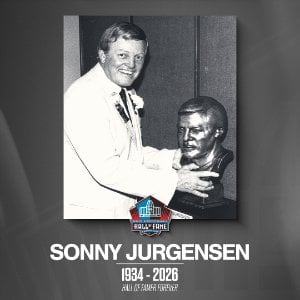 The football world today is celebrating the life and career of SONNY JURGENSEN, a record-setting quarterback who became a fixture and fan favorite in Washington for more than six decades.
Elected as a member of the Pro Football Hall of Fame’s Class of 1983 after an 18-year NFL playing career that began in Philadelphia, Jurgensen died early Friday, according to his family. He was 91.
“Few players could rival Sonny Jurgensen’s genuine love of the game that continued long after his playing days,” said Jim Porter, the Hall of Fame’s president & CEO. “Whether he was standing tall in the face of an opposing lineman as a quarterback for the Eagles and Redskins for 18 seasons or later as a beloved broadcaster in Washington for several more decades, Sonny captivated audiences and introduced generations of fans to the sport. Watching Sonny throw a football was like watching a master craftsman create a work of art.”
Born on Aug. 23, 1934 in Wilmington, N.C., Christian Adolph Jurgensen II was known to everyone as Sonny. He will be remembered as one of the game’s great pocket passers despite an everyman’s body and an unorthodox throwing motion that several coaches wanted to “correct.”
Jurgensen, rarely one to hold back an opinion, refused to alter his windmill delivery, nor cease with the occasional behind-the-back throw or left-handed toss.
“If the ball gets there before the defender, who cares?” he said in an interview with NFL Films.
Teammates and scouts marveled at his accuracy, with one opposing team’s personnel director saying, “If you play man-to-man, he’ll beat you. If you play zone, he’ll completely pick you apart.”
Every pass, it seemed, was a perfect spiral.
“Sonny Jurgensen was the best passer I ever played against. I mean pure passer,” said Hall of Fame safety PAUL KRAUSE, who began his career as a Washington teammate of Jurgensen’s, then faced him as an opponent with the Vikings.
“I haven’t seen anyone who could handle a football in the manner that the redhead could,” Washington flanker and Hall of Famer BOBBY MITCHELL said. “And I’ve often said: ‘He could hit a gnat at 50 (yards) if he wanted to.’”
Jurgensen enjoyed one of his best seasons in 1967, teaming with Mitchell and another future Hall of Famer, CHARLEY TAYLOR, to lead the league in nearly every major passing statistic: 288 completions, 508 attempts, 3,747 yards and 31 touchdowns. The completions and yardage also set NFL records, and he threw at least one TD pass in every game, continuing a string that began in 1966 and lasted into 1968 for 23 games overall.
Pete Retzlaff, a receiver who played with Jurgensen in Philadelphia, said he couldn’t remember him ever “throwing behind me or throwing down to where I had to pick the ball up below my knees to catch it. No matter what pattern you were running, if you were going to break free, that ball was always there.”
The Eagles selected Jurgensen in the fourth round with the 43rd overall pick of the 1957 NFL Draft. He was a multi-sport athlete – baseball, basketball (his favorite sport as a youth) and tennis – whose 10 career interceptions as a defensive back at Duke received almost as much acclaim as his modest college passing statistics.
In his Enshrinement speech, Jurgensen gave credit to another Duke graduate and Hall of Famer for his opportunity to play in the NFL.
“I really wasn't schooled for coming into professional football,” he said. “If it hadn't had been for an assistant coach there by the name of CLARENCE 'ACE' PARKER, who is enshrined right here in this Hall, telling professional scouts that I had the God-given talent to throw the football, I doubt very seriously that I would ever have the chance to play.”
Jurgensen started four games as a rookie, winning three, but he quickly found himself behind NORM VAN BROCKLIN, another future Hall of Famer, who joined the Eagles in 1958.
“I learned a lot from him,” Jurgensen said in crediting Van Brocklin for his development. “I was a student of the game – and had to be.”
Together they would help the Eagles win the 1960 NFL title, Jurgensen’s lone championship team, by passing for nearly 3,000 yards and 29 touchdowns in 12 games.
Hall of Famer SAM HUFF – later Jurgensen’s teammate, broadcasting partner and best friend – recalled an early scouting report on the Eagles he got while with the New York Giants. He was advised not to knock Van Brocklin out of the game.
“Because if you do, Sonny Jurgensen is going to come in,” Huff said a coach told him. “And you don’t want to play against Sonny Jurgensen, because he can really throw that football.”
When Van Brocklin retired following the championship season to become head coach of the expansion Minnesota Vikings, Jurgensen took over the starting role. He kept the Eagles among the league’s top passing offenses over the next two seasons.
Given his first real opportunity to “throw that football,” Jurgensen earned All-Pro honors and the first of his five Pro Bowl nods in 1961. His breakout year included a then NFL-record 3,723 passing yards and 32 touchdown passes, which tied the league record and remained a team record until 2017. The team went 10-3-1, one-half game out of the playoffs.
He followed that season by again leading the league with 3,261 passing yards, but the 1962 Eagles struggled to a 3-10-1 record and finished last in their division. When Jurgensen missed a chunk of the 1963 season due to injury, team management decided it was time to look elsewhere.
Payback time
Jurgensen was traded to Washington for another quarterback. Publicly, he called it “an opportunity to start fresh again.” Privately, he kept score, and payback came in the first meeting with his former team in one of his best individual performances.When the Eagles came to Washington on Oct. 11, 1964, Jurgensen threw for 385 yards and five TDs – two each to Mitchell and Taylor – in a 35-20 win.
“After they traded me, it was always a special game for me,” Jurgensen said of the matchups against the Eagles.
Jurgenson missed much of the 1968 season because of broken ribs and elbow surgery but won the passing championship again in 1969 with league-highs of 274 completions, 442 attempts and 3,102 yards. He also threw 22 touchdown passes.
More importantly, Washington posted a winning record – its first in 13 seasons – under first-year coach and future Hall of Famer VINCE LOMBARDI. Jurgensen called the 7-5-2 season the highlight of his career.
“I never worked so hard and was in better condition. … I was never better prepared nor did I have more fun than that one year,” Jurgensen said in his Enshrinement speech. In a different interview, he summed it up this way: “I had a coach. I finally had a coach.”
Mitchell noted that until that season, “Sonny basically coached himself.”
The admiration was mutual, with Lombardi commenting after a game, “Jurgensen is a great quarterback. He hangs in there under adverse conditions. He may be the best the league has ever seen. He is the best I have seen.”
When Lombardi passed away before the 1970 season, Washington promoted an assistant coach and reverted to a 6-8 record. The following year, GEORGE ALLEN, another future Hall of Famer, restored a winning record, but he and Jurgensen never saw eye to eye.
Struggles in Washington
Injuries and Allen’s preference for Billy Kilmer’s more conservative style pushed Jurgensen to No. 2 on the depth chart. He started only 13 games from 1971-74, even though the team posted an 11-2 record in them. He missed all of the “Over the Hill Gang’s” playoff run to Super Bowl VII in 1972 after tearing an Achilles tendon.In those final seasons, however, Jurgensen cemented his reputation for late-game heroics.
One such game occurred Dec. 2, 1973. Trailing the Giants 24-13 with roughly eight minutes remaining, a hobbled Jurgensen proceeded to lead two scoring drives, covering 71 and 73 yards. He completed all 11 passes he attempted in those drives for 129 yards, including the game-winner to Larry Brown on a flair pass that covered 16 yards. Jurgensen, who had not played in a month, was in the game only because the Giants had knocked out Kilmer in the third quarter.
As the New York Times put it, “When Billy limped off the field, he passed Sonny limping on. But there was no limp in Jurgensen’s passing arm.”
When told Jurgensen had eaten up his defense, Giants coach Alex Webster replied, “Yeah, from a wheelchair.”
In a bitter twist, Jurgensen’s last game also was his lone appearance in a playoff contest. He replaced Kilmer in Washington’s 19-10 loss to the Los Angeles Rams in 1974.
For his career, Jurgensen amassed 2,433 completions, 32,224 passing yards, 255 touchdowns, five 3,000-yard seasons and a handful of NFL records at the time of his retirement. He was a member of the NFL’s All-Decade Team of the 1960s.
Post-football career
After retiring as a player, Jurgensen joined CBS as a color commentator for six seasons. In 1981, he stayed with the Washington franchise exclusively, reuniting with Huff in the booth. He worked until 2019, when he again retired, ending a 38-year broadcasting career in Washington.His association with the city that revered him lasted for 62 years.
Jurgensen served on the Code of Support Foundation board, a nonprofit serving U.S. service members, veterans and their families. He also co-hosted an annual charity golf tournament for several years.
Chris Cooley, who traveled and worked with Jurgensen on radio broadcasts over several seasons late in Jurgensen’s career, said of him: “Sonny is honest, and I love that about him. He never took himself too seriously.”
Jurgensen said once of his carefree persona that resonated with fans: “I had as much fun playing as anyone. But on the field, it was serious business. I was interested in winning.”
His legacy, as one of the game’s great passers and as “Sonny,” will be preserved forever at the Pro Football Hall of Fame in Canton, Ohio.
Previous Article
Super Bowl LX preview: Hall of Famers’ records in sight
When the 2025 NFL season culminates with Super Bowl LX on Sunday, Feb. 8, players and coaches from the Seattle Seahawks and New England Patriots have the opportunity to break decades-old records set by members of the Pro Football Hall of Famer. Here's a look at some of those records.
Next Article
Pro Football Hall of Fame to enshrine five in Class of 2026
The newest members of the Pro Football Hall of Fame are quarterback DREW BREES, running back ROGER CRAIG, wide receiver LARRY FITZGERALD, linebacker LUKE KUECHLY and placekicker ADAM VINATIERI. They comprise the Class of 2026 presented by Visual Edge IT.